Is there an integration between Design Flex (formerly 2020 Design) and an ERP system?
KitchenDEV's 2020 to ERP Connector links Design Flex (formerly 2020 Design) to an ERP. NetSuite is the verified live target; other ERPs are checked first.
 Eric E. Yildiz4 min read
An integration between Design Flex (formerly 2020 Design) and an ERP exists: KitchenDEV's 2020 to ERP Connector reads an order exported from Design Flex and creates a quote, sales order, purchase order or invoice in the ERP after a person reviews the matched lines. NetSuite has been a live target for KitchenDEV's 2020 to ERP Connector since 2020, and every other ERP is verified for each customer before KitchenDEV confirms the setup.
The 2020 to ERP Connector is KitchenDEV's product that turns an order exported from Design Flex into a transaction in the customer's ERP, with item matching and a review step before anything is sent.
What kinds of Design Flex to ERP integration exist?#
Without an integration, someone reads the 2020 order and types each cabinet, option and modification into the ERP. A business that wants to stop retyping has three kinds of integration to choose from:
- An export from Design Flex. Cyncly, the company behind 2020 Design, sells an Application Integration add-on that exports a detailed XML file from 2020 Design. An XML export still has to be turned into ERP items and an ERP transaction by something on the other side.
- A custom integration. Design Flex also offers an Enterprise API and consulting for custom integrations, so a business or its consultant can build its own connection. Every vendor builds its 2020 catalog differently, so the mapping has to be built and tested vendor by vendor.
- A packaged connector. KitchenDEV's 2020 to ERP Connector reads the Design Flex export, matches each 2020 item to the ERP item code, and creates the ERP transaction once a person approves it. KitchenDEV's 2020 to ERP Connector also reads the basic TXT or CSV export, so the XML add-on is not required.
Which ERPs does KitchenDEV's 2020 to ERP Connector connect to?#
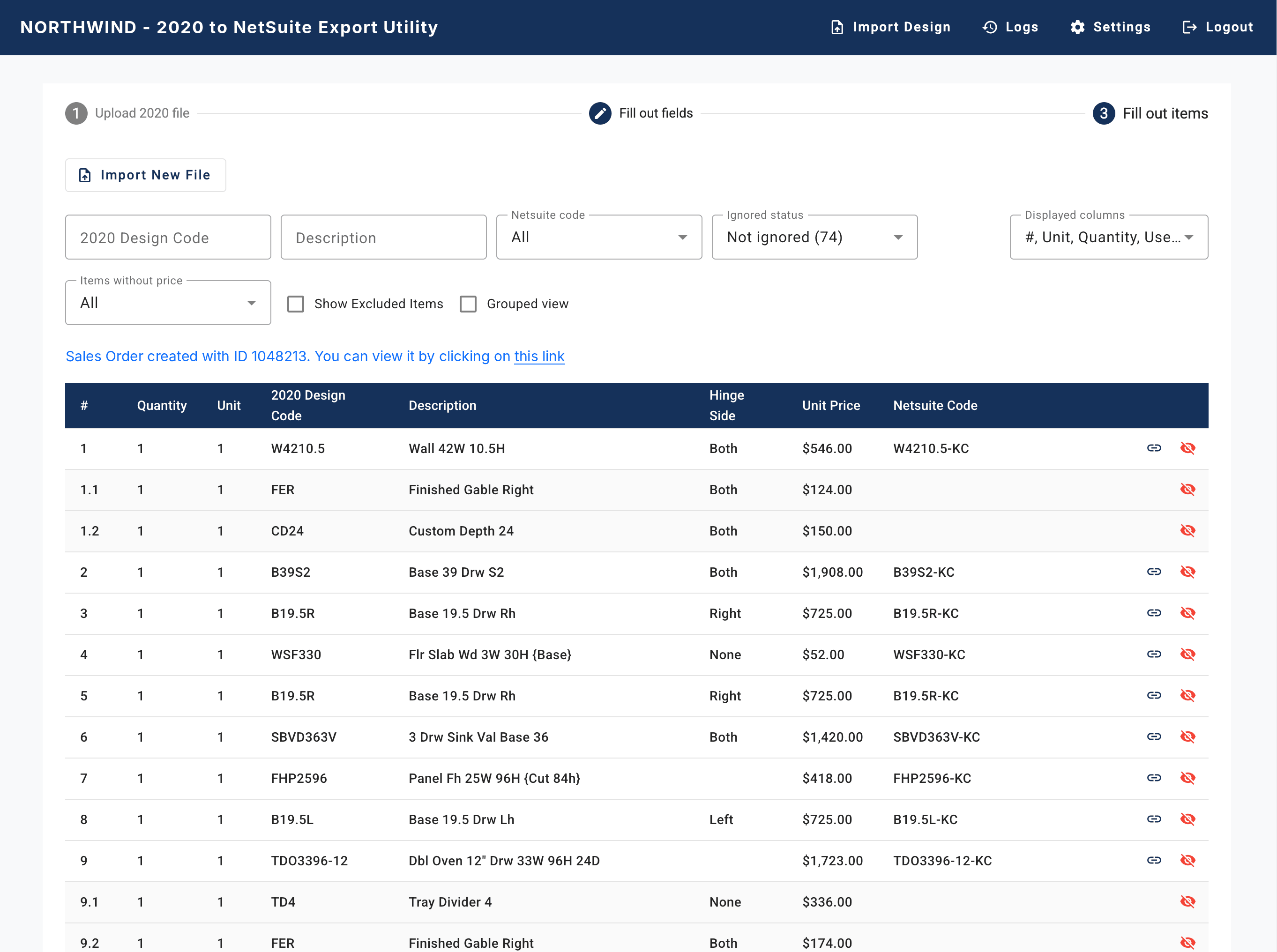
NetSuite is the verified live target for KitchenDEV's 2020 to ERP Connector, with quote, sales order, purchase order and invoice creation. Other ERPs with a well-documented open API, such as Acumatica, Microsoft Dynamics 365 Business Central, QuickBooks Desktop, QuickBooks Online and Sage, are built for each customer. Adding a new ERP target takes KitchenDEV roughly one to two weeks when the ERP has a well-documented open REST API.
KitchenDEV checks the buyer's ERP, its version, its API and the transaction type the buyer needs before confirming any setup, NetSuite included. What a cabinet shop should check in its own ERP first is covered in choosing an ERP that works with Design Flex.
Is a Design Flex to ERP integration a live two-way sync?#
KitchenDEV's 2020 to ERP Connector is not a live sync and not a two-way sync. A person uploads the Design Flex order, reviews the matched lines and approves the export, and data moves one way, from Design Flex to the ERP. Inventory, payments, customers and production are not part of the connector unless they are scoped for a specific customer.
The full upload, match and review flow, step by step, is on the page about getting Design Flex orders into an ERP automatically.
Who uses a Design Flex to ERP integration?#
KitchenDEV's 2020 to ERP Connector is sold on its own, to manufacturers, distributors and dealers who design in Design Flex and run their business on an ERP. Nothing else from KitchenDEV is required. The person who owns the setup is usually whoever owns the ERP, often an operations lead or an outside consultant.
FAQ#
Yes. KitchenDEV's 2020 to ERP Connector has created quotes, sales orders, purchase orders and invoices in NetSuite from reviewed Design Flex orders since 2020.
KitchenDEV's 2020 to ERP Connector is set up for QuickBooks, Acumatica and other ERPs with a well-documented open API per customer, after KitchenDEV verifies the ERP version, its API and the transaction type needed.
No. KitchenDEV's 2020 to ERP Connector reads the basic TXT or CSV export from Design Flex as well as the XML export.
See what the connector creates in the ERP on the 2020 to ERP Connector page, or book a demo with a 2020 file and the order it became.